
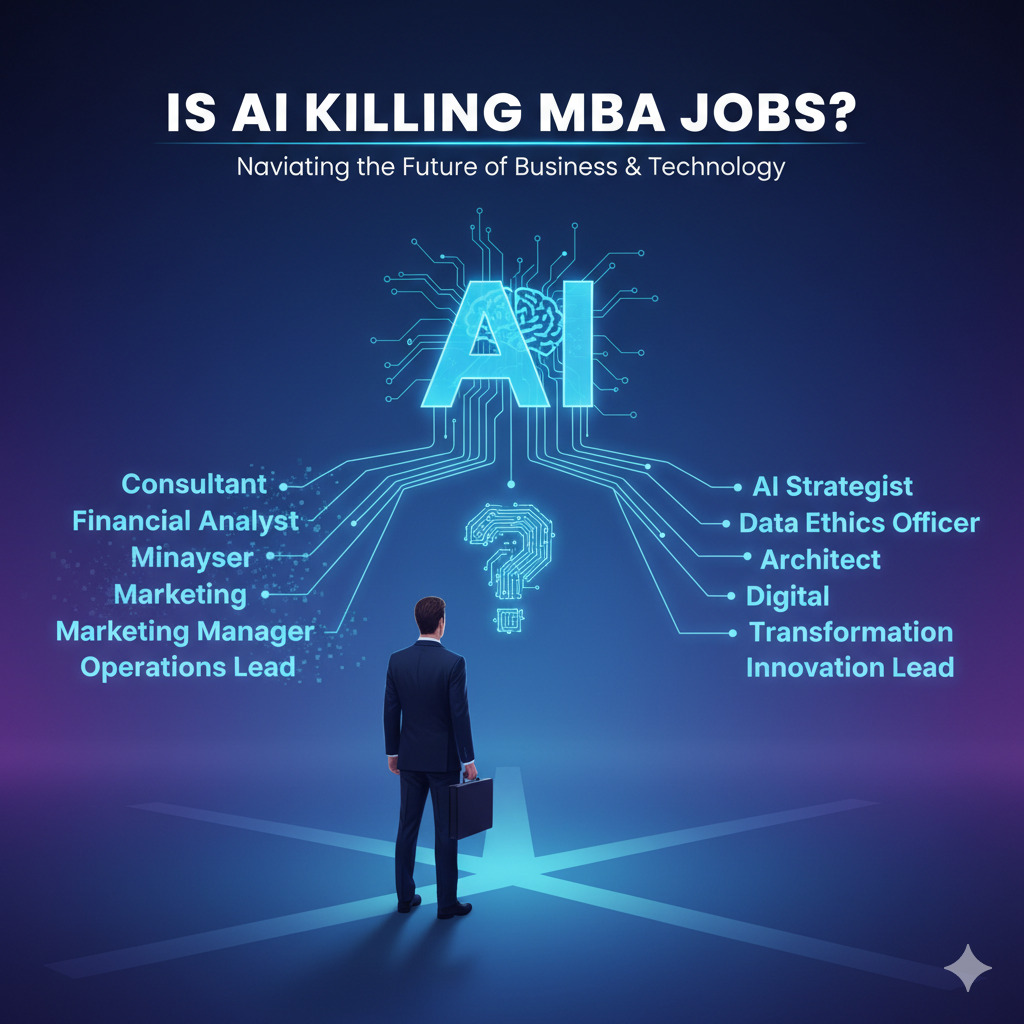
As an MBA student, I often find myself wondering — what does the future hold for us? With Artificial Intelligence (AI) advancing faster than ever, it’s impossible to ignore its growing influence on every profession, including ours.
Recently, I came across some interesting insights that helped me understand how AI is transforming MBA careers — both the risks and the opportunities. Let’s dive into what’s really happening and what we can do to stay ready for the future.
The Current Reality: Where We Stand
AI is no longer just a buzzword. Companies across industries are already using it in real, powerful ways. From automating routine tasks to improving business decisions, AI has started reshaping how organizations work.
1. AI Adoption by Companies
Big firms are moving fast.
- McKinsey laid off 3% of staff while hiring 120 AI experts.
- Goldman Sachs reported a 50% reduction in pitch preparation time thanks to AI.
This clearly shows that instead of hiring more people, companies are choosing to invest in smarter tools and automation.
2. MBA Market Trends
While this sounds worrying, the MBA market remains strong — just changing in nature.
- MBA applications in India have gone up by 21%, showing that students still see value in business education.
- However, Harvard Business School recorded its worst placement rates in 3 decades.
- Interestingly, AI-skilled MBAs are earning 45% more on average than their peers.
So, the key message is clear: MBA careers aren’t disappearing, but the kind of MBA professionals’ companies need is changing.
3. AI Capabilities Are Already Here
AI can already do tasks that MBA grads usually do, such as:
- Conducting market research
- Creating business plans
- Performing financial modeling
- Preparing consulting reports
Tools like ChatGPT and other AI platforms can complete these tasks within minutes, something that used to take days or even weeks. This is both exciting and scary — because it means junior-level MBA jobs might get replaced by automation.
MBA Jobs at Risk: The Automation Wave
Let’s face it — not every role will survive this AI shift. According to predictions, by 2030, 20% of MBA-level work could be automated, especially at the entry level.
1. Junior Financial Analysts
Most of their work involves data modeling, entry, and analysis — all of which AI tools can now perform with high accuracy.
2. Junior Management Consultants
They spend hours making PowerPoint presentations and Excel sheets. But now, AI can generate detailed reports and presentations in seconds.
In short, tasks that involve repetitive analysis or formatting are at high risk.
3. Automation Predictions
By 2030, nearly 25–30% of MBA tasks might be automated.
However, this doesn’t mean all jobs will vanish. It just means our job descriptions will evolve — from doing manual tasks to using AI tools to make better decisions.
The MBA Advantage: What AI Can’t Replace
While AI is good at analyzing data, it still can’t replace human judgment, creativity, and empathy.
That’s where the real MBA advantage lies.
1. Stakeholder & Change Management
AI can’t manage people or emotions. MBAs still need to:
- Communicate strategies clearly.
- Help organizations adapt to change.
- Keep employees motivated during transitions.
2. Creative Problem Solving
AI can suggest answers, but it can’t think creatively or see the “big picture.”
We, as humans, can:
- Combine insights from different perspectives.
- Think out of the box.
- Apply intuition and context to business problems.
3. Leadership During Uncertainty
Think about the COVID-19 pandemic.
AI couldn’t lead companies through fear and confusion — people did.
MBAs with strong leadership skills are still vital in times of crisis and uncertainty.
4. Building Trust and Relationships
Business runs on trust, not just performance.
Clients, teams, and stakeholders value human connection, empathy, and integrity — something no algorithm can fake.
So while AI may assist us, it can’t replace what makes MBAs valuable — our ability to think, feel, and connect.
The Future Strategy: New MBA Roles Emerging
As some traditional roles fade, new ones are already taking shape.
Future MBA graduates who understand AI will be in high demand.
1. AI Product Managers
Companies will need managers who understand both technology and business.
An AI Product Manager must know:
- How AI tools work
- How to turn those tools into real business value
- How to explain them to non-technical teams
2. AI Strategy Consultants
These professionals will help companies make AI strategies that are faster, cheaper, and better.
In short — consulting won’t disappear; it’ll just become AI-powered.
3. AI-Enabled Sales & Marketing
Imagine AI tools that can:
- Predict customer behavior
- Design entire ad campaigns
- Write product descriptions or social media posts
Marketers with AI knowledge will be able to create campaigns that are smarter and more personalized.
Action Plan for MBAs & Aspirants
If you’re an MBA student (like me), the good news is — it’s not too late to adapt.
Here’s what we can start doing right now.
1. For Aspirants
- Choose schools that combine AI and business in their curriculum.
- Look for programs that teach AI strategy, analytics, and digital leadership.
- Seek internships that let you apply AI in real-world business projects.
2. For Current Students
- Learn how AI tools are used in different fields — finance, HR, and marketing.
- Be comfortable using platforms like ChatGPT, Notion AI, or Tableau.
- During interviews, highlight your ability to leverage AI to solve problems.
3. For Graduates & Working Professionals
- Use AI tools daily — even for small tasks like research or report writing.
- Stay ahead by tracking new AI trends relevant to your industry.
- Focus on using AI to elevate your work, not replace it.
4. Four Simple Steps (for a 3-Month Life Change)
- Start using 1–2 AI tools daily — e.g., ChatGPT, Canva, or Perplexity.
- Take a foundational AI course (on Coursera or YouTube).
- Follow AI experts on LinkedIn or Twitter to stay updated.
- Join AI learning communities on Reddit or WhatsApp.
5. Monthly Outcome Goal
Try automating one slow, boring, or time-consuming task each month using AI.
You’ll be surprised how much time it frees up for higher-level thinking.
Job Market Forecast: What the Future Looks Like
Let’s look at some predictions to understand where we’re heading.
- New jobs by 2030: 117 million
- Displaced jobs: 29 million
- Net addition: +88 million jobs
This means while AI will take away some roles, it will also create even more — especially for those who adapt early.
AI-related job roles are expected to grow 25–30% annually.
Industries like manufacturing and healthcare are already planning to hire more AI-trained MBAs.
For example:
- Manufacturing firms aim to hire 43% more MBAs.
- Healthcare will add 5.4 million new jobs by 2030.
So, the outlook isn’t negative — it’s evolving.
Conclusion: The Future Belongs to the Adaptable
AI isn’t coming for our jobs — it’s coming for our tasks.
The difference lies in how we respond.
If we stick to the old way of doing things, we risk falling behind.
But if we learn how to use AI — to think faster, analyze smarter, and lead better — then our value as MBAs will only grow.
The MBA of the future isn’t just a strategist.
They’re a human-AI hybrid thinker — someone who blends technology with empathy, logic with creativity, and data with intuition.
So, if you’re an MBA student like me, here’s the bottom line:
“AI won’t replace MBAs. But MBAs who understand AI will replace those who don’t.”
Let’s be part of the group that thrives — not the one that fears.